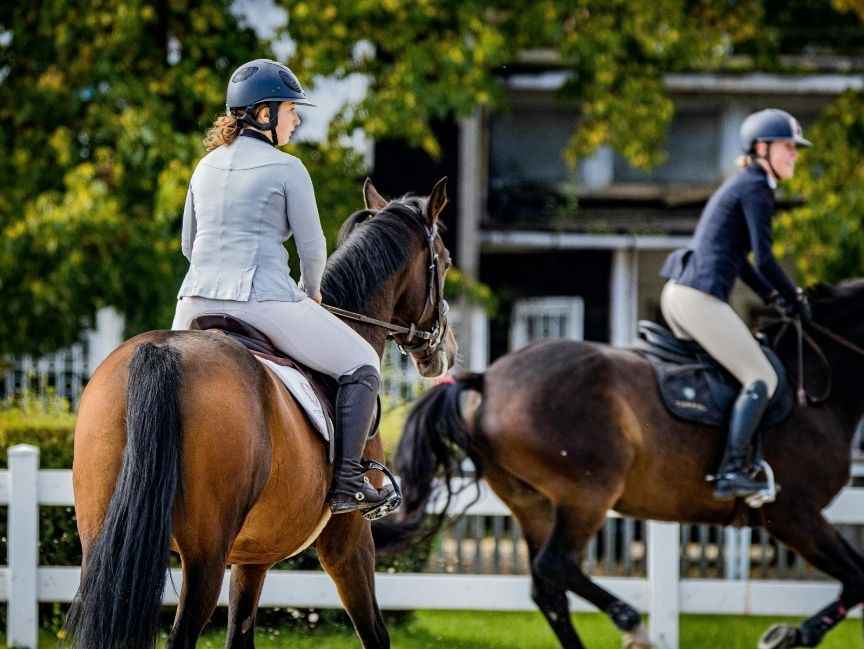
Every rider has been reminded at some stage to lift their gaze. Perhaps, like me, you heard it from a parent, an instructor, or an old poem shared by a grandparent. While we don’t need to stare permanently between our horse’s ears, keeping the eyes up plays a far bigger role in riding than many people realise. It shapes balance, awareness, communication, and confidence—both yours and your horse’s.
Here are the key reasons why this simple habit can make such a profound difference.
In busy arenas or warm-up rings, riders who look down become unpredictable obstacles. You may have seen near-collisions caused by someone who didn’t notice the traffic around them. When your gaze is up and ahead, you can anticipate the movement of other horses, choose safe lines, and maintain good ring etiquette. It’s one of the simplest ways to stay safe in shared spaces.
Many ridden patterns and competition tests rely on accurate lines, turns, and transitions. By lifting your eyes to the next marker—and even the one beyond—you naturally ride straighter, smoother lines. Your body aligns with your intention, and your horse responds accordingly. Looking down shortens your focus and often leads to drifting or wobbling off the intended path.
Good riders notice what is happening outside the arena as well as inside it. A loose dog, a flapping tarp, or a fast-approaching vehicle can unsettle even the most reliable horse. By keeping your gaze outward, you stay ahead of potential problems and can make calm, early decisions that prevent accidents.
Feeling your horse’s impulsion should come from your seat and legs—not from watching their head. When you lift your focus, your body becomes more attuned to the sway, lift, and rhythm beneath you. You become more sensitive to whether your horse is truly working forward or simply giving the impression of energy.
If your arena has mirrors, looking up helps you use them effectively to check straightness. Even without mirrors, you can use quick visual checks—like glancing over each shoulder to see equal amounts of hindquarters. Straightness is a key foundation of correct training, and lifting your gaze supports both the visual and physical feel of it.
Good feel is impossible if you’re out of balance. Looking up helps align your spine, allowing your seat and core to work correctly. On a crooked horse, you will feel unevenness in the saddle, and on a straight horse you will feel level through your body. This subtle awareness only develops fully when your posture is correct—and that begins with your gaze.
A dropped head often results in a tilted neck or collapsed shoulder, which creates a chain reaction through the rider’s whole body. Horses, being masters of compensation, reflect this imbalance. Over time, this creates crookedness in the horse that becomes harder to correct. By staying upright and looking ahead, you encourage your horse to stay straighter and more evenly balanced.
Your head accounts for roughly ten per cent of your body weight. When it tips forward, that weight shifts onto your horse’s forehand, affecting balance, transitions, and overall performance. Looking up redistributes your weight more evenly through the saddle, helping your horse stay lighter in front and more engaged behind.
Across disciplines, a well-aligned rider is the foundation of effective communication. Ear–shoulder–hip–heel alignment is much easier to maintain when the rider looks ahead rather than down. Few, if any, riding styles consider a downward gaze part of a correct position. A lifted focus helps you sit taller, breathe better, and ride with quiet confidence.
Watch beginner jumping classes and you’ll see a clear pattern: riders who look down often experience more refusals. Fixating on the jump itself causes tension, hesitation, and a forward-tipping posture. When riders look beyond the fence, their balance improves and their horses read the direction confidently. A simple change of eye line can dramatically reduce refusals and create a more harmonious approach.
Looking up may seem like a minor adjustment, but its influence on your balance, communication, and overall safety is enormous. Whether you’re schooling on the flat, hacking out, or jumping a course, your eyes set the tone for the rest of your body—and your horse will follow that lead.
Developing this habit builds confidence, clarity, and a smoother, more effective partnership with your horse. And that’s something worth lifting your head for.